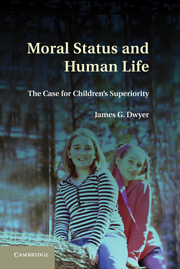
Moral status and human life : the case for children's superiority
"Are children of equal, lesser, or perhaps even greater moral importance than adults? This work of applied moral philosophy develops a comprehensive account of how adults as moral agents ascribe moral status to beings - ourselves and others - and on the basis of that account identifies multiple...
| Main Author: | |
|---|---|
| Format: | Book |
| Language: | English |
| Published: |
Cambridge :
Cambridge University Press ,
c2011
|
| Subjects: | |
| Online Access: | Table of contents only Contributor biographical information Cover image Publisher description |
MARC
| LEADER | 00000cam a2200000 7i4500 | ||
|---|---|---|---|
| 001 | 0000079672 | ||
| 005 | 20121101093000.0 | ||
| 008 | 100727s2011 enk eng | ||
| 020 | |a 0521766915 (hardback : alk. paper) | ||
| 020 | |a 9780521766913 (hardback : alk. paper) | ||
| 050 | 0 | 0 | |a HQ767.9 |b .D89 2011 |
| 090 | 0 | 0 | |a HQ767.9 |b .D89 2011 |
| 100 | 1 | |a Dwyer, James G. , |d 1961- , |e author | |
| 245 | 1 | 0 | |a Moral status and human life : |b the case for children's superiority |c James G. Dwyer |
| 260 | |a Cambridge : |b Cambridge University Press , |c c2011 | ||
| 300 | |a viii, 212 p. : |b ill. ; |c 24 cm. | ||
| 504 | |a Includes bibliographical references (p. 203-208) and index | ||
| 505 | 0 | |a 1. What is moral status and why does it matter? -- 2. How is moral status determined? -- 3. Selecting criteria of moral status -- 4. Problems in applying a multi-criterial approach -- 5. Applying a multi-criteria moral status test to adults and children -- 6. Legal, policy, and moral implications of children's superiority | |
| 520 | |a "Are children of equal, lesser, or perhaps even greater moral importance than adults? This work of applied moral philosophy develops a comprehensive account of how adults as moral agents ascribe moral status to beings - ourselves and others - and on the basis of that account identifies multiple criteria for having moral status. It argues that proper application of those criteria should lead us to treat children as of greater moral importance than adults. This conclusion presents a basis for critiquing existing social practices, many of which implicitly presuppose that children occupy an inferior status, and for suggesting how government policy, law, and social life might be different if it reflected an assumption that children are actually of superior status" | ||
| 650 | 0 | |a Children | |
| 650 | 0 | |a Social status |x Moral and ethical aspects | |
| 856 | 4 | 1 | |3 Table of contents only |u http://www.loc.gov/catdir/enhancements/fy1011/2010031691-t.html |
| 856 | 4 | 2 | |3 Contributor biographical information |u http://www.loc.gov/catdir/enhancements/fy1011/2010031691-b.html |
| 856 | 4 | 2 | |3 Cover image |u http://assets.cambridge.org/97805217/66913/cover/9780521766913.jpg |
| 856 | 4 | 2 | |3 Publisher description |u http://www.loc.gov/catdir/enhancements/fy1011/2010031691-d.html |
| 999 | |a 1000149774 |b Book |c OPEN SHELF (30 DAYS) |e Gong Badak Campus | ||