Modeling and simulation of reactors for methanol production by CO2 reduction: A comparative study
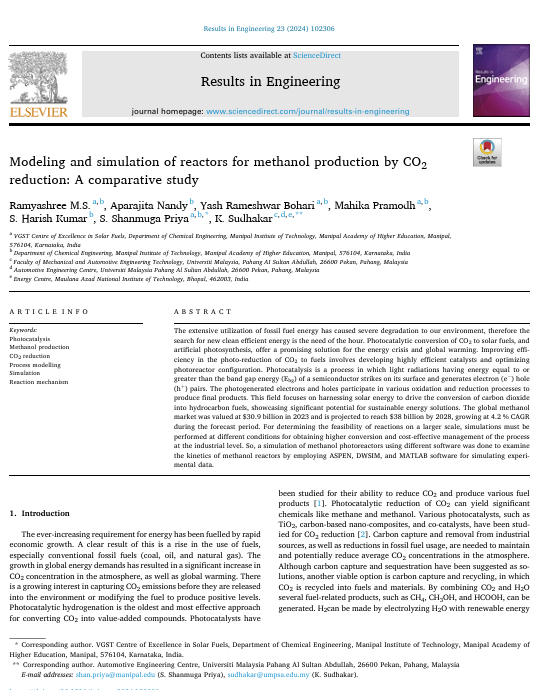
The extensive utilization of fossil fuel energy has caused severe degradation to our environment, therefore the search for new clean efficient energy is the need of the hour. Photocatalytic conversion of CO2 to solar fuels, and artificial photosynthesis, offer a promising solution for the energy cri...
| Main Authors: | , , , , , , |
|---|---|
| Format: | Article |
| Language: | English |
| Published: |
Elsevier B.V.
2024
|
| Subjects: | |
| Online Access: | http://umpir.ump.edu.my/id/eprint/41916/ http://umpir.ump.edu.my/id/eprint/41916/8/Modelling%20and%20simulation.PNG |
| _version_ | 1848826468555030528 |
|---|---|
| author | Ramyashree, M. S. Nandy, Aparajita Bohari, Yash Rameshwar Pramodh, Mahika Kumar, S. Harish Priya, S. Shanmuga Sudhakar, Kumarasamy |
| author_facet | Ramyashree, M. S. Nandy, Aparajita Bohari, Yash Rameshwar Pramodh, Mahika Kumar, S. Harish Priya, S. Shanmuga Sudhakar, Kumarasamy |
| author_sort | Ramyashree, M. S. |
| building | UMP Institutional Repository |
| collection | Online Access |
| description | The extensive utilization of fossil fuel energy has caused severe degradation to our environment, therefore the search for new clean efficient energy is the need of the hour. Photocatalytic conversion of CO2 to solar fuels, and artificial photosynthesis, offer a promising solution for the energy crisis and global warming. Improving efficiency in the photo-reduction of CO2 to fuels involves developing highly efficient catalysts and optimizing photoreactor configuration. Photocatalysis is a process in which light radiations having energy equal to or greater than the band gap energy (Ebg) of a semiconductor strikes on its surface and generates electron (e−) hole(h+) pairs. The photogenerated electrons and holes participate in various oxidation and reduction processes to produce final products. This field focuses on harnessing solar energy to drive the conversion of carbon dioxide into hydrocarbon fuels, showcasing significant potential for sustainable energy solutions. The global methanol market was valued at $30.9 billion in 2023 and is projected to reach $38 billion by 2028, growing at 4.2 % CAGR during the forecast period. For determining the feasibility of reactions on a larger scale, simulations must be performed at different conditions for obtaining higher conversion and cost-effective management of the process at the industrial level. So, a simulation of methanol photoreactors using different software was done to examine the kinetics of methanol reactors by employing ASPEN, DWSIM, and MATLAB software for simulating experimental data. |
| first_indexed | 2025-11-15T03:45:18Z |
| format | Article |
| id | ump-41916 |
| institution | Universiti Malaysia Pahang |
| institution_category | Local University |
| language | English |
| last_indexed | 2025-11-15T03:45:18Z |
| publishDate | 2024 |
| publisher | Elsevier B.V. |
| recordtype | eprints |
| repository_type | Digital Repository |
| spelling | ump-419162025-04-07T08:10:31Z http://umpir.ump.edu.my/id/eprint/41916/ Modeling and simulation of reactors for methanol production by CO2 reduction: A comparative study Ramyashree, M. S. Nandy, Aparajita Bohari, Yash Rameshwar Pramodh, Mahika Kumar, S. Harish Priya, S. Shanmuga Sudhakar, Kumarasamy TJ Mechanical engineering and machinery The extensive utilization of fossil fuel energy has caused severe degradation to our environment, therefore the search for new clean efficient energy is the need of the hour. Photocatalytic conversion of CO2 to solar fuels, and artificial photosynthesis, offer a promising solution for the energy crisis and global warming. Improving efficiency in the photo-reduction of CO2 to fuels involves developing highly efficient catalysts and optimizing photoreactor configuration. Photocatalysis is a process in which light radiations having energy equal to or greater than the band gap energy (Ebg) of a semiconductor strikes on its surface and generates electron (e−) hole(h+) pairs. The photogenerated electrons and holes participate in various oxidation and reduction processes to produce final products. This field focuses on harnessing solar energy to drive the conversion of carbon dioxide into hydrocarbon fuels, showcasing significant potential for sustainable energy solutions. The global methanol market was valued at $30.9 billion in 2023 and is projected to reach $38 billion by 2028, growing at 4.2 % CAGR during the forecast period. For determining the feasibility of reactions on a larger scale, simulations must be performed at different conditions for obtaining higher conversion and cost-effective management of the process at the industrial level. So, a simulation of methanol photoreactors using different software was done to examine the kinetics of methanol reactors by employing ASPEN, DWSIM, and MATLAB software for simulating experimental data. Elsevier B.V. 2024-05-25 Article PeerReviewed pdf en http://umpir.ump.edu.my/id/eprint/41916/8/Modelling%20and%20simulation.PNG Ramyashree, M. S. and Nandy, Aparajita and Bohari, Yash Rameshwar and Pramodh, Mahika and Kumar, S. Harish and Priya, S. Shanmuga and Sudhakar, Kumarasamy (2024) Modeling and simulation of reactors for methanol production by CO2 reduction: A comparative study. Results in Engineering, 23 (102306). pp. 1-17. ISSN 2590-1230. (Published) https://doi.org/10.1016/j.rineng.2024.102306 https://doi.org/10.1016/j.rineng.2024.102306 |
| spellingShingle | TJ Mechanical engineering and machinery Ramyashree, M. S. Nandy, Aparajita Bohari, Yash Rameshwar Pramodh, Mahika Kumar, S. Harish Priya, S. Shanmuga Sudhakar, Kumarasamy Modeling and simulation of reactors for methanol production by CO2 reduction: A comparative study |
| title | Modeling and simulation of reactors for methanol production by CO2 reduction: A comparative study |
| title_full | Modeling and simulation of reactors for methanol production by CO2 reduction: A comparative study |
| title_fullStr | Modeling and simulation of reactors for methanol production by CO2 reduction: A comparative study |
| title_full_unstemmed | Modeling and simulation of reactors for methanol production by CO2 reduction: A comparative study |
| title_short | Modeling and simulation of reactors for methanol production by CO2 reduction: A comparative study |
| title_sort | modeling and simulation of reactors for methanol production by co2 reduction: a comparative study |
| topic | TJ Mechanical engineering and machinery |
| url | http://umpir.ump.edu.my/id/eprint/41916/ http://umpir.ump.edu.my/id/eprint/41916/ http://umpir.ump.edu.my/id/eprint/41916/ http://umpir.ump.edu.my/id/eprint/41916/8/Modelling%20and%20simulation.PNG |